
High-Level Meeting
High-Level Meeting of Directors-General and Presidents of the National Statistical Institutes
Dublin hosted a high-level meeting of the heads of national statistical institutes, organised by the Central Statistics Office, Ireland in cooperation with Eurostat.
The focus of the meeting in September 2026 was “Simplification and the European Statistical System”.
Conclusions from the Dublin HLM
Simplification and Burden Reduction in European official statistics
3-4 September 2026
The High-Level Meeting (HLM) of Director’s General and Presidents of the National Statistical Institutes (NSIs) in the European Statistical System (ESS) and Eurostat reaffirmed the strategic importance of simplifying and reducing EU statistical reporting requirements with a view to reducing the burden on respondents and costs in national authorities while ensuring continuous relevance and quality of European official statistics.
Reflecting on the progress to date, the HLM commended the excellent work done by the ESS Directors and Expert Groups to collect an initial list of proposals and in particular Eurostat, to accelerate the assembly of a simplification package that set out both short-term and medium- to longer-term objectives.
The HLM emphasised the necessity of transforming their shared commitment to simplification into tangible actions and underlined the need for leadership and direction on where to make reductions that are both responsible and impactful.
The HLM welcomed the proposed five-strand-approach for defining both short-term and medium- to longer-term actions. These strands are:
-
- Simplifying and reducing reporting requirements in EU Statistical Legislation through preparing an omnibus package of delegated and implementing acts by the end of the first quarter 2027;
- Simplifying and reducing burden of quality and metadata reporting;
- Reinforcing the implementation of the “only-once principle” in European Official Statistics;
- Simplification by design in the preparation of EU statistical legislation;
- Non-legislative actions to simplify processes and facilitate statistical reporting.
The HLM Discussion Paper (PDF 431KB) detailing these strands is available to download.
The HLM emphasised the necessity of reducing the current burden as well as avoiding building burden for the future. A particular emphasis was placed on incorporating the “collect once-only” principle while developing EU legislative proposals. Harnessing the power of administrative data at both the national and European level is seen as an essential element in meeting the simplification objective.
The HLM discussed the ESS’s role in engaging with the owners of data systems, including provision of advice on data content, standards and structures to enable the re-use of administrative data holdings for statistical purposes.
To support the objective of simplification by design, the HLM stressed the importance of structuring, as much as possible, emerging EU legislative proposals around maximising the re-use of existing or emerging data sources for the compilation of European official statistics, in accordance with the “once-only” principle. By means of an example, the HLM acknowledged the emergence of data-rich, EU-wide systems in the business domain (in particular, the opportunities of ViDA and the EU Customs Data Hub) as data sources with high potential for reuse and reducing the reporting burden of parallel data collections in the medium/longer term. The HLM also encouraged the continued exploration of simplification opportunities in the short- to medium term arising from emerging EU legislative proposals for existing requirements.
The HLM also underlined that simplification should be pursued through rationalization and greater consistency across statistical domains, including the identification of overlaps, duplications and inconsistencies in existing reporting requirements, concepts, definitions and transmission obligations.
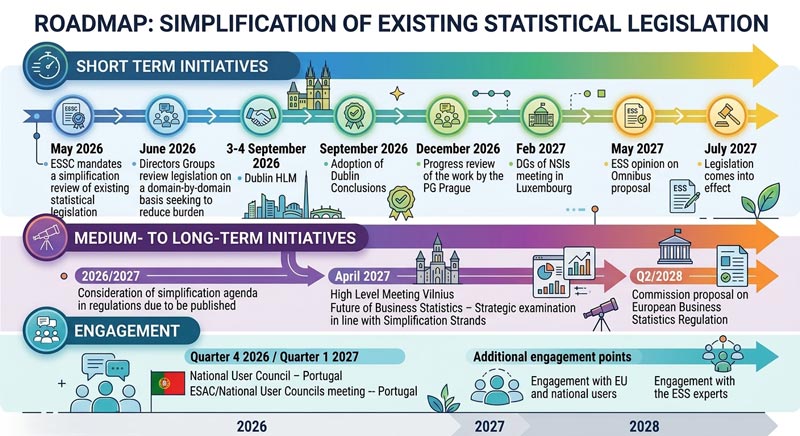
The HLM identified the revision of the Regulation on European Business Statistics (Commission proposal foreseen for the first half of 2028) as a key opportunity for reducing burden on business and progressing the simplification agenda. In particular, the embedding of the only-once principle should be at its core. To this end, the HLM recommended that the next High-Level Meeting, due to take place in April under the Lithuanian Presidency of the EU Council, should focus on the transformation of European Business Statistics and the broader learnings that can be gained from the simplification opportunities this transformation presents. The HLM also noted the opportunities that could be explored in legislation that is more mature in its development, for example, legislation on European System of National Accounts, Integrated Farm Statistics and Tourism Statistics.
The HLM also acknowledged the opportunity to improve ESS processes on data transmission, promoting greater automation and interoperability across the ESS, as well as to enhance the quality and metadata reporting. The relevant ESS Working Groups will be invited to make specific proposals for simplification of quality and metadata reporting in their domains which could be included in the Simplification Omnibus in 2027. In addition, the ESS Working Group on Quality will be invited to make proposals on simplification of SIMS and consider how metadata can support AI use of official statistics.
The HLM underlined the importance of the listening to the voice of the users of European official statistics. User engagement plays a significant role in the simplification process. The identification of and the engagement with key users will be central to the successful implementation of the elements of the simplification package particularly where user needs may not be fully met. In this regard, the HLM noted the role of ESAC and the upcoming opportunity to engage with users at the meeting of national user councils hosted by Statistics Portugal on 20 and 21 October 2026. Key users at EU level (e.g. the European Commission services and ECB) will also be consulted by Eurostat. The voice of the NSIs will play an important role in these consultations. Engagement and communication strategies will be required throughout the simplification process.
The HLM agreed to assess the impact of the proposals on burden reduction for businesses and NSIs. Additional information may be requested from NSIs for this purpose.
In summary, the HLM reaffirmed its commitment to the Commission’s strategic objective of simplification with a clear need for concrete actions to enact these strategic goals. The HLM accepted that consensus may not always emerge within the ESS, but this should not impede progress while acknowledging individual Member States flexibility to maintain production for national reasons.
The HLM also highlighted the importance of simplification in creating capacity for innovation, modernisation and the development of new data sources and methodologies.
The HLM discussions underlined the commitment of Directors-General and Presidents to delivering measurable results with regular reporting and engagement on the short-, medium- and long-term objectives at ESSC and as important inputs to engagement with teams across the NSIs and Eurostat on the simplification initiatives.
The HLM called for a detailed roadmap as a means of measuring progress and informing users. This roadmap should distinguish between short-term simplification measures, including the omnibus package, and medium and longer-term actions aimed at the rationalisation and modernisation of the ESS.
To maintain momentum, and to continue providing strategic guidance to the process, it was agreed that the ESSC Partnership group will support Eurostat in the development of the omnibus package, including a broad categorisation based on the impact of each proposal. Further consultations with the respective Directors Groups on this first part of the simplification programme is expected before the end of 2026 to provide input to the preparation of the draft omnibus package.
The HLM agreed to review the progress made on the simplification package at a meeting to be conducted back-to-back with the February ESSC in Luxembourg with a view to the ESSC giving strategic guidance on its content, prioritisation and balance. Discussions on user engagement and on progressing quality reporting and metadata reform could also be included in the agenda of that meeting.
The ESSC is expected to be formally presented with the omnibus simplification proposal in May 2027 with the formal adoption to follow if a favourable opinion is delivered.
Delegate Information Note
For information on accreditation, venue, accommodation, transport, accessibility requirements and other practical arrangements, please download the Practical Information Note for Delegates (PDF 386KB) .
Date & Venue
The meeting will take place on 3rd – 4th September 2026, in Farmleigh House, Phoenix Park, Dublin 15.
Phoenix Park
The Phoenix Park is one of the largest enclosed public parks in any capital city in Europe. It was originally created as a royal hunting Park in the 1660s and opened to the public in 1747. A large herd of wild fallow deer still remain to this day. The Park is also home to the Phoenix Park Visitor Centre, Áras an Uachtaráin (the official residence of the President of Ireland), Zoological Gardens, Victorian Flower Gardens, a Biodiversity Information Centre, cafés and Tea Rooms.

Farmleigh House
Farmleigh House is a beautifully preserved Edwardian house situated on an elevated position above the River Liffey in the northwest of the Phoenix Park.
Formerly one of the Dublin residences of the Guinness family, Farmleigh serves as the official Irish State Guest House.

Hotel Accommodation
Rooms for all delegates have been reserved in the Trinity City Hotel, Pearse Street, Dublin 2, D02 FW96. This hotel is 10km from the meeting venue.
The reservation process is through the accreditation system. An email inviting you to register, book accommodation etc, will issue directly to delegates in due course.

Evening Dinner Venue
The dinner will be held on 3rd September at Fire Steakhouse, Dawson St, Dublin at 19:00.

Transport
Delegates are invited to make their own travel arrangements from the airport to the Trinity City Hotel.
Transport will be provided from the hotel to Farmleigh on both mornings, and from Farmleigh back to the hotel on the evening of the 3rd. Transport will be provided to Dublin Airport/City Centre following the conclusion of the meeting.
Weather
Temperatures in Dublin in September: Average daily highs range from 15-17°C, while overnight lows typically drop to 9-11°C. Rain can be expected at any time of year.
Draft Agenda
Day 1: Thursday, 03 September 2026
|
Time |
Session / Event |
|
08:45 |
Transfer from Hotel to Farmleigh |
|
09:30 – 10:15 |
Registration, tea & coffee |
|
10:15 – 10:30 |
Opening & welcome by Jennifer Banim, Director General and Mariana Kotzeva |
|
10:30 – 11:00 |
Simplification Package outline - Mariana Kotzeva |
|
11:00 - 13:00 |
Session 1: Simplification Package |
|
13:00 – 14:00 |
Lunch, house tour and family photo |
|
14:00 - 17:00 |
Session 2: Other Simplification Paths |
|
17:00 – 17:30 |
Wrap up and Summation |
|
17:30 |
Transfer from Farmleigh House to Trinity City Hotel |
|
19:00 |
Dinner |
Day 2: Friday, 04 September 2026
|
Time |
Session / Event |
|
08:45 |
Transfer from Hotel to Farmleigh |
|
09:30 – 09:40 |
Introduction to Day 2 |
|
09:40 – 11:30 |
Session 3: User perspectives |
|
11:30 – 12:30 |
Summary and next steps on the Simplification package |
|
12:30 – 12:45 |
Closing remarks |
|
12:45 – 14:00 |
Lunch |
|
14:00 |
Transfer from Farmleigh House to Dublin Airport |